Building a Retail Laundry Central Processing Facility: From 800 Garments to a Scalable Operation
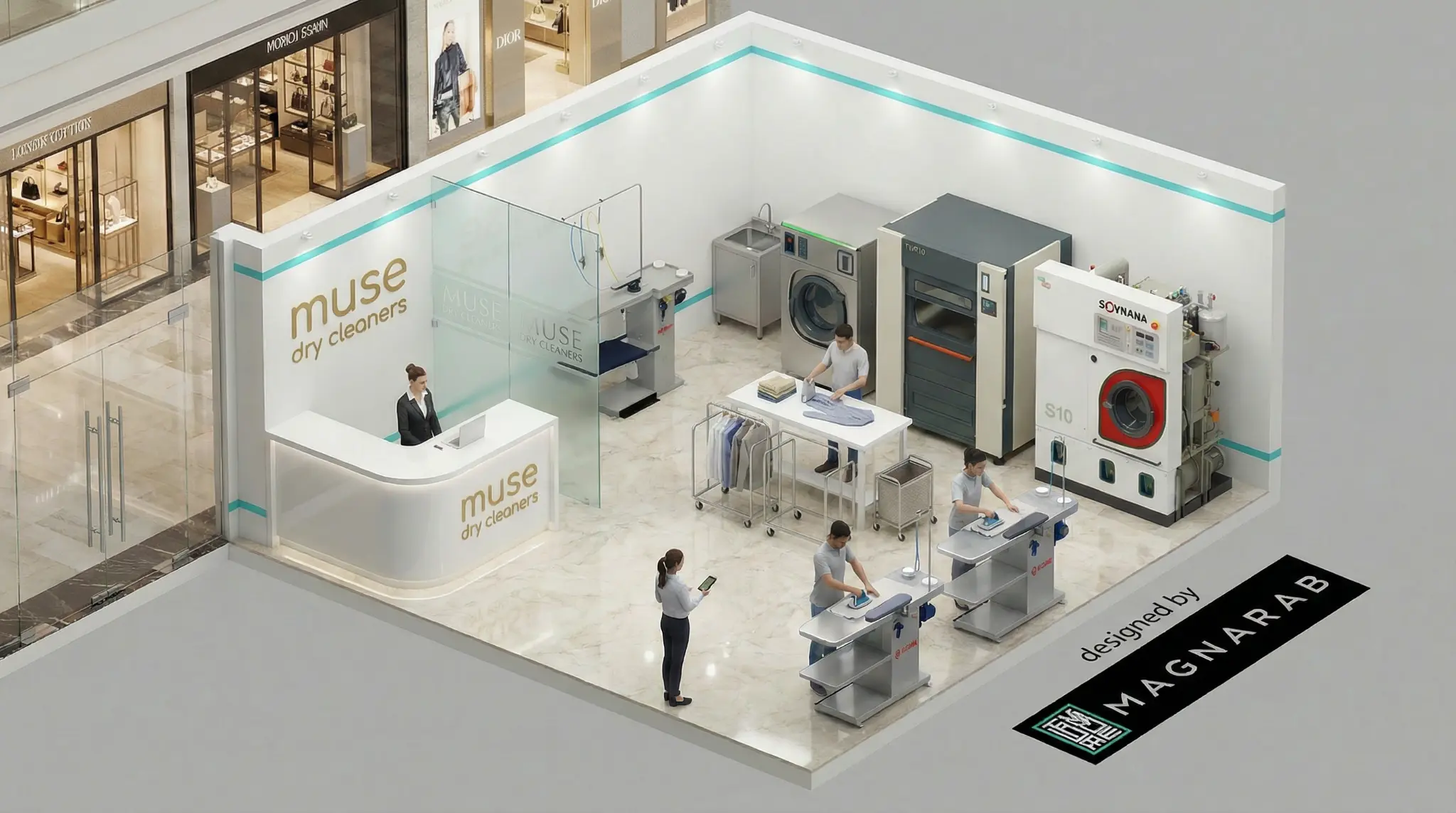
When a first-time entrepreneur in a major Indian metro approached MAGNARAB to design a central processing facility for a retail laundry and dry cleaning business, the conversation started with a simple question: How do I build a laundry that can grow with me?
The answer was not a list of machines. It was a complete operational blueprint — from capacity modeling and equipment sizing to logistics design, technology integration, and a phased investment plan. This article walks through the methodology MAGNARAB used to design this facility, and the principles that apply to anyone planning a retail laundry with a centralized backend.
The Brief
The client was planning a retail laundry and dry cleaning operation serving a densely populated urban market. The business model was built around a network of collection points and direct pickup-and-delivery, with all garment processing handled at a single central facility.
The key requirements were:
- Phase 1 capacity of 800 garments per shift, scaling to 2,400 garments per day in Phase 2
- Two-shift operation from day one, with infrastructure designed to support a third shift as demand grows
- A full garment care range — wet washing, dry cleaning, pressing, finishing, and flat linen processing
- Technology-driven operations — barcode tracking, automated workflow management, and customer notifications from the start
- A realistic investment plan that separates machinery, infrastructure, and software costs for clear financial planning
Capacity Planning: Building the Model
MAGNARAB's approach to retail laundry design starts with the demand model, not the equipment catalog. For this project, the capacity model was built from the following assumptions:
| Parameter | Value |
|---|---|
| Phase 1 capacity | 800 garments per shift |
| Phase 2 target | 2,400 garments per day |
| Operating shifts | 2 (Phase 1), expandable to 3 |
| Average garments per order | 6 |
| Orders per delivery staff per day | 15 |
The 800-garments-per-shift target was derived from the projected collection point network and direct pickup volume in the first 6 to 12 months of operation. The Phase 2 target of 2,400 garments per day represents the facility's full capacity across three shifts — achievable without additional equipment, purely by extending operating hours.
Key insight: Designing for Phase 2 capacity from the start means the equipment investment is made once. Growth comes from adding shifts and delivery staff, not from buying more machines. This is the fundamental advantage of a centralized processing model.
The Business Model: Collection Points + Direct Pickup
The retail laundry was designed to operate through two parallel channels:
Collection Points — small, low-cost retail locations (often shared or co-located) where customers drop off and pick up garments. These require minimal equipment — just a counter, a tagging station, and a software terminal.
Direct Pickup & Delivery — motorbike-based pickup for individual orders and small vans for bulk delivery runs. Each delivery staff member handles approximately 15 orders per day, with an average of 6 garments per order.
All garments flow to the central processing facility, where they are sorted, tagged, processed, quality-checked, and dispatched back to the collection point or directly to the customer's address.
This model keeps the retail footprint light and the capital concentrated where it matters most — in the processing facility itself.
Garment Tracking: Barcode Tagging from Day One
One of the non-negotiable elements of the design was a barcode tagging system for every garment entering the facility. Each garment receives a unique barcode tag at the point of collection, which follows it through every stage of processing — from sorting to washing, drying, finishing, quality check, and dispatch.
The tagging system was integrated with a laundry automation platform that provides:
- Real-time garment tracking — know the exact status of every garment at every stage
- Order management — link garments to customer orders, collection points, and delivery schedules
- Customer notifications — automated SMS or app notifications at key milestones (received, processing, ready, dispatched)
- Production workflow monitoring — track throughput, bottlenecks, and cycle times in real time
- Management dashboard — daily production reports, delivery performance, and revenue analytics
The cost of barcode tagging at this scale is minimal — approximately 3 rupees per garment — but the operational visibility it provides is transformative. Without it, a multi-channel retail laundry quickly loses control of garment flow, leading to misplaced items, missed SLAs, and customer complaints.
Equipment Selection: The Complete Line
The equipment package for this facility was designed to handle the full range of retail garment care — from everyday clothing to delicate dry-clean-only items and flat linen. The core machinery includes:
| Equipment | Quantity | Purpose |
|---|---|---|
| Washer Extractor (10 kg) | 4 | High-capacity wet washing for everyday garments |
| Tumble Dryer (28 kg) | 4 | Matched drying capacity with headroom for heavy loads |
| Dry Cleaning Machine (10 kg) | 1 | Solvent-based cleaning for delicate and labeled items |
| Hydro Extractor | 1 | High-speed moisture removal for wet-cleaned items |
| Spotting Cabinet | 1 | Pre-treatment of stains before washing or dry cleaning |
| Steam Vacuum Pressing Table | 5 | Primary finishing station for shirts, trousers, and garments |
| Form Finisher | 1 | Automated finishing for jackets, coats, and structured garments |
| Trouser Topper | 1 | Dedicated pressing for trouser waistbands and pleats |
| Flatwork Ironer (3.3 m) | 1 | Processing of bed linen, tablecloths, and flat items |
| Drying Cabinet | 1 | Low-temperature drying for delicates and specialty items |
The equipment was selected and sized to deliver 800+ garments per shift with built-in redundancy. The four washer-extractors and four tumble dryers ensure that if one unit is down for maintenance, the line continues without a significant drop in throughput.
The five steam vacuum pressing tables are the backbone of the finishing line — pressing is typically the bottleneck in retail laundry operations, and under-investing in pressing capacity is one of the most common mistakes in facility design.
Utilities and Infrastructure
A central processing facility of this scale requires significant backend infrastructure that is often underestimated in early-stage planning:
Steam Generation — a boiler system with 1.5 tons per hour steam capacity was specified to support the washers, dryers, pressing tables, and ironer simultaneously. The boiler room includes a complete setup with feed water treatment, condensate return, and safety systems.
Laundry Infrastructure — this covers the full mechanical, electrical, and plumbing (MEP) scope:
- Water supply and treatment systems
- Compressed air for pneumatic equipment
- Steam distribution and condensate return lines
- Electrical installation (three-phase power distribution)
- Drainage with lint traps and effluent management
- Storage tanks and plumbing
The infrastructure investment is substantial — but it is a one-time cost that supports the facility through Phase 1, Phase 2, and beyond. Cutting corners on infrastructure leads to equipment underperformance, higher operating costs, and expensive retrofits later.
Investment Breakdown
The total investment for this facility was structured into three clear categories:
| Component | Budget |
|---|---|
| Laundry machinery (washers, dryers, DC machine, pressing, finishing) | Approximately 55–60% of total |
| Boiler, utilities, and infrastructure (steam, water, electrical, plumbing) | Approximately 35–40% of total |
| Software platform (laundry automation, barcode system, dashboards) | Approximately 5–7% of total |
This breakdown is typical for a well-designed retail laundry central processing facility. The machinery gets the most attention, but the infrastructure and software components are what determine whether the facility actually runs efficiently at scale.
Key insight: Many first-time laundry investors focus exclusively on the machinery budget and are surprised by the infrastructure costs. MAGNARAB always presents a complete investment picture — machinery, MEP, software, and consulting — so there are no surprises during execution.
Consulting and Support: The MAGNARAB Approach
For this project, MAGNARAB provided end-to-end consulting and support over a 6-month engagement:
- Facility layout design — optimized workflow from receiving to dispatch
- Equipment selection — sized and configured for the specific garment mix and volume
- Workflow design — process flows for each garment category (wet wash, dry clean, press-only, flat linen)
- Installation supervision — on-site oversight during equipment installation and commissioning
- Staff training — hands-on training for operators, supervisors, and quality control staff
- Operational launch support — on-site support during the first weeks of live operation
Staff training is a critical and often overlooked component. The best equipment in the world will underperform if the operators do not understand the correct wash programs, chemical dosing, pressing techniques, and quality standards. MAGNARAB conducts training at its own operational facilities, where trainees work on live production — not in a classroom.
Lessons for Your Retail Laundry Project
Whether you are planning a single-city retail laundry or a multi-city franchise, the principles are the same:
- Start with the demand model — know your garment volume, order size, and delivery frequency before you size equipment. The capacity model drives every downstream decision.
- Design the facility for Phase 2 from day one — buy the right equipment once and grow by adding shifts, not machines. This is the most capital-efficient path to scale.
- Invest in technology early — barcode tagging and workflow automation are not luxuries. They are the foundation of operational control in a multi-channel retail laundry.
- Budget for infrastructure honestly — boiler, water treatment, electrical, and plumbing will represent 35–40% of your total investment. Plan for it.
- Do not skip the finishing line — pressing is the bottleneck. Under-investing in pressing capacity will limit your throughput long before your washers are at capacity.
- Get operational support, not just equipment — a laundry is a production operation. You need someone who understands how laundries run, not just how machines are installed.
What MAGNARAB Brings to the Table
MAGNARAB combines real laundry operations experience with deep engineering knowledge, retail business understanding, and advanced software automation. We do not just design laundries — we build successful laundry businesses.
If you are planning a retail laundry central processing facility — whether it is a startup operation or an expansion of an existing network — MAGNARAB can help you get it right from day one.
Interested in a similar project?
Planning a dry cleaning operation? Take our quick assessment to get tailored recommendations.
Dry Cleaning Studio Assessment