Tunnel Washer vs. Divided Cylinder: Choosing the Right Washing Technology for Your Laundry
The biggest technology decision in any commercial laundry project is the primary washing system. For decades, the industry default for large-volume operations has been the continuous batch washer — commonly known as the tunnel washer. It promises high throughput, low water consumption per kilogram, and automation that reduces labor dependency.
But there is a growing counter-argument, particularly in markets where laundries handle Customer Owned Goods (COG) — garments and linen belonging to multiple individual clients rather than a single institution's bulk inventory. In these environments, the tunnel washer's greatest strength becomes its greatest weakness.
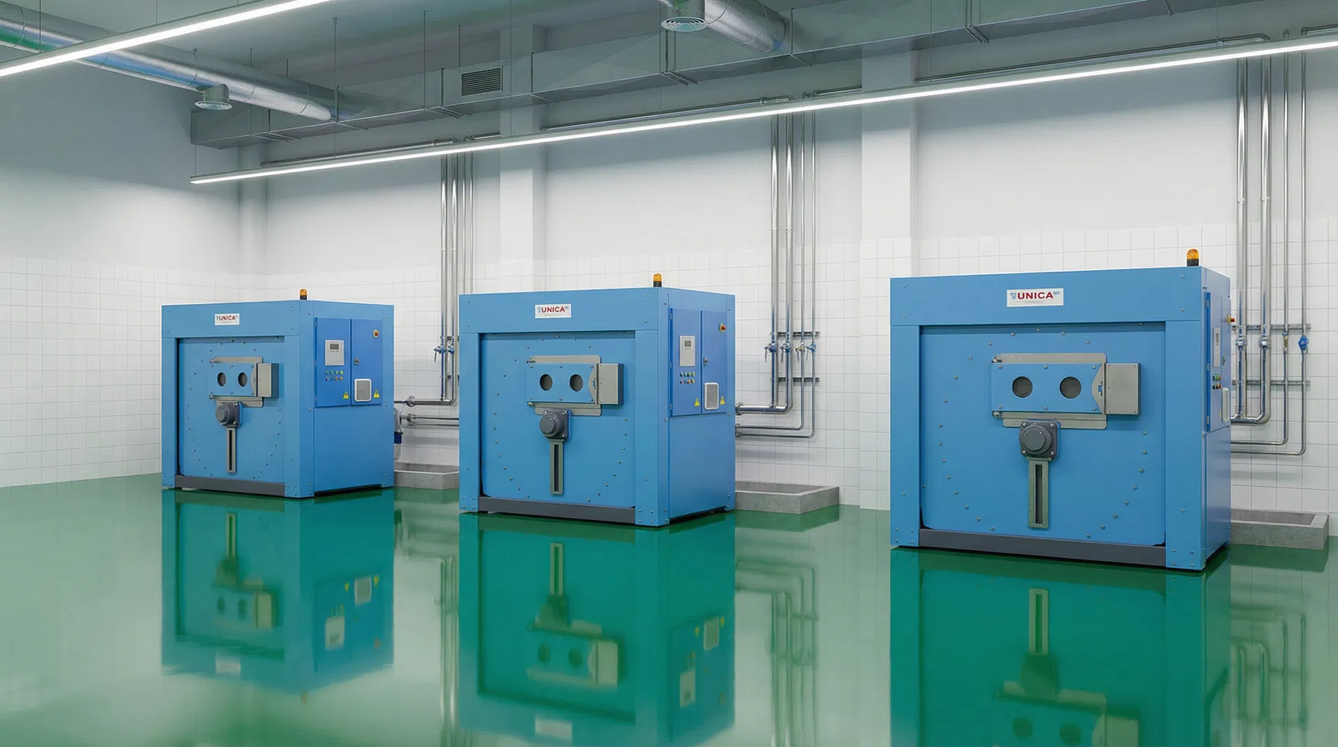
This article examines the case for divided cylinder technology as an alternative to tunnel systems, using the UNICA Type 200/3 as the reference machine — a front-loading compartmentalized washer manufactured in Belgium since 1932.
The Customer Owned Goods Problem
In mature Western markets, a hospital or hotel group might feed a single type of linen into a tunnel washer in continuous batches. The linen belongs to one owner, follows one wash program, and exits in a predictable stream. Tunnel washers were designed for exactly this scenario.
The Middle East, South Asia, and many emerging markets operate differently. Commercial laundries in these regions process Customer Owned Goods — uniforms from one company, bed linen from a hotel, personal garments from a retail customer, and specialty items from a restaurant, all arriving in the same shift. Each client's goods must be tracked, washed according to specific requirements, and returned without mixing.
Batching different clients' linen together in a tunnel washer creates a logistical nightmare. Post-wash separation is nearly impossible when hundreds of items from dozens of clients exit the tunnel in a continuous stream. The result is lost items, cross-contamination complaints, and an operations team spending more time sorting than washing.
A new greenfield project should focus on fundamentals — on-time delivery to customers, specialized quality in washing and stain removal, sensible capital expenditure, and eliminating maintenance shocks. Large tunnel-based projects are becoming obsolete for COG operations. Smart investors rely on solid fundamentals and digital logistics systems rather than inflexible machinery.
Four Problems with Tunnel Washers in COG Environments
Single Point of Failure
When a tunnel washer goes down, the entire laundry stops. Every minute of downtime costs revenue and erodes customer trust. There is no partial operation — the system is either running at full capacity or not running at all.
Complex Infrastructure Requirements
Tunnel washers demand specialized IT systems, instrumentation engineers, and sophisticated control systems just to keep running. The maintenance team needs skills that go far beyond standard mechanical knowledge, and sourcing replacement parts or specialist technicians in many markets is neither fast nor cheap.
The COG Separation Impossibility
Customer Owned Goods cannot be batched together and separated after washing. The fundamental design of a tunnel — continuous flow of mixed items through shared chambers — is incompatible with the requirement to keep each client's goods isolated throughout the process.
One Wash Mode for All
Most tunnel systems process everything in a single soil-removing mode. But different fabrics, soil levels, and garment types demand different treatment. A hotel's white bed sheets, a factory's oil-stained coveralls, and a restaurant's delicate table linen all require distinct wash programs — something a single-mode tunnel cannot deliver.
The Divided Cylinder Alternative: UNICA Type 200/3
The UNICA Type 200/3 is a front-loading washer with three independent compartments (pockets), each capable of running its own wash program simultaneously. Manufactured in Belgium since 1932, the machine represents a fundamentally different philosophy: independence, flexibility, and predictable operation over decades.
Technical Specifications
| Parameter | Value |
|---|---|
| Loading Capacity | 200 kg per cycle |
| Pockets | 3 independent compartments |
| Drum Diameter | 1,500 mm |
| Drum Depth | 1,100 mm |
| Wash Speed | 25 rpm |
| Extraction Speed | 650 rpm |
| G-Factor | 360 |
| Power Supply | 380–440V / 50A |
| Water Inlet | 2" |
| Steam Inlet | 1" |
| Compressed Air | 3/8" |
| Machine Weight | 5,800 kg |
Each pocket processes different soil levels and linen types with individual wash programs — true flexibility for COG operations. One pocket can run a heavy-soil program for industrial uniforms while another handles a delicate cycle for fine linen, all in the same machine at the same time.
Built for Decades
UNICA machines have a documented track record of running for 30+ years with zero shocks or surprises. There are no hidden maintenance costs, no sudden control system failures, and no dependency on proprietary software updates. The machine is mechanical, robust, and designed to outlast the building it sits in.
Operational Independence
If one machine requires service, the others keep running. In a facility with three UNICA 200/3 units, losing one machine means losing one-third of capacity temporarily — not the entire operation. There is no single point of failure.
Accessible Maintenance
Standard mechanical skills are sufficient to maintain a UNICA. There is no need for IT specialists, instrumentation engineers, or factory-trained technicians flying in from Europe. Any competent industrial mechanic can service the machine with readily available tools and parts.
Water Recovery Ready
Major breakthroughs in water re-use systems have closed the utility gap between divided cylinder washers and tunnel systems. Modern water recovery installations allow UNICA operators to reclaim and reuse wash water, bringing per-kilogram water consumption close to tunnel washer levels while retaining all the operational advantages.
Head-to-Head Comparison
The following table presents a transparent comparison across the dimensions that matter most to laundry investors and operators.
| Aspect | Tunnel Washer | UNICA 200/3 |
|---|---|---|
| COG Handling | Cannot separate individual customer loads post-wash | Each pocket processes different customer loads independently |
| Wash Program Flexibility | Single soil-removing mode for entire batch | Individual wash programs per cycle, per machine |
| Standby Capability | Entire system stops when one module fails | Other machines continue operating during service |
| Risk of Linen Damage | Clothes can get blocked in the tunnel mechanism | Standard drum rotation — no blockage risk |
| Operator Skill Level | Requires heavily experienced operators | Standard training sufficient for daily operation |
| Engineering Support | Requires IT, instrumentation, and specialized engineers | Standard mechanical maintenance only |
| Maintenance Predictability | Complex systems create unpredictable maintenance shocks | 30+ years of proven, predictable service life |
| Capital Expenditure | Massive upfront investment in integrated system | Sensible, modular investment — scale as you grow |
| Dependency Risk | Total dependency on single system availability | Zero single points of failure — true independence |
| Utility Consumption | Lower water consumption per kg (historically) | Gap closing rapidly with water re-use systems |
| System Complexity | Highly complex — IT, sensors, conveyors, controls | Simple, robust, proven mechanical design |
"Tunnel washers are inevitable for very large projects — but large, centralized projects are becoming obsolete. Smart investors should rely on fundamentals and digital logistics systems. The laundry can spend time on quality-improving values rather than saving on utilities."
— MAGNARAB Consulting
When Does a Tunnel Still Make Sense?
It would be misleading to suggest that tunnel washers have no place in modern laundry operations. For very high-volume, single-owner linen processing — a 50-ton-per-day hospital laundry or a cruise line's centralized facility — tunnel systems deliver unmatched throughput efficiency. The key distinction is ownership of the goods being processed.
When the laundry processes its own institution's linen (or a single client's bulk linen under a long-term contract), the tunnel's continuous batch model works. When the laundry handles COG from multiple clients with different requirements, the divided cylinder approach delivers better operational outcomes, lower risk, and more predictable economics.
The MAGNARAB Approach
MAGNARAB does not sell machines — we design laundry philosophies. Every project starts with understanding the market, the client mix, the linen types, and the operational model before any equipment is specified. For facilities handling Customer Owned Goods, we consistently recommend divided cylinder technology because the operational fundamentals are stronger.
Our involvement spans the entire project lifecycle: feasibility studies and technology selection, precision installation engineering with 3D renderings and utility planning, project management through commissioning, and long-term operational support. When we recommend UNICA, it is because we have seen these machines deliver decades of uninterrupted service in the most demanding environments.
If you are planning a new laundry facility or evaluating your current washing technology, MAGNARAB's consulting team can help you make the right decision — one based on fundamentals, not marketing brochures.